
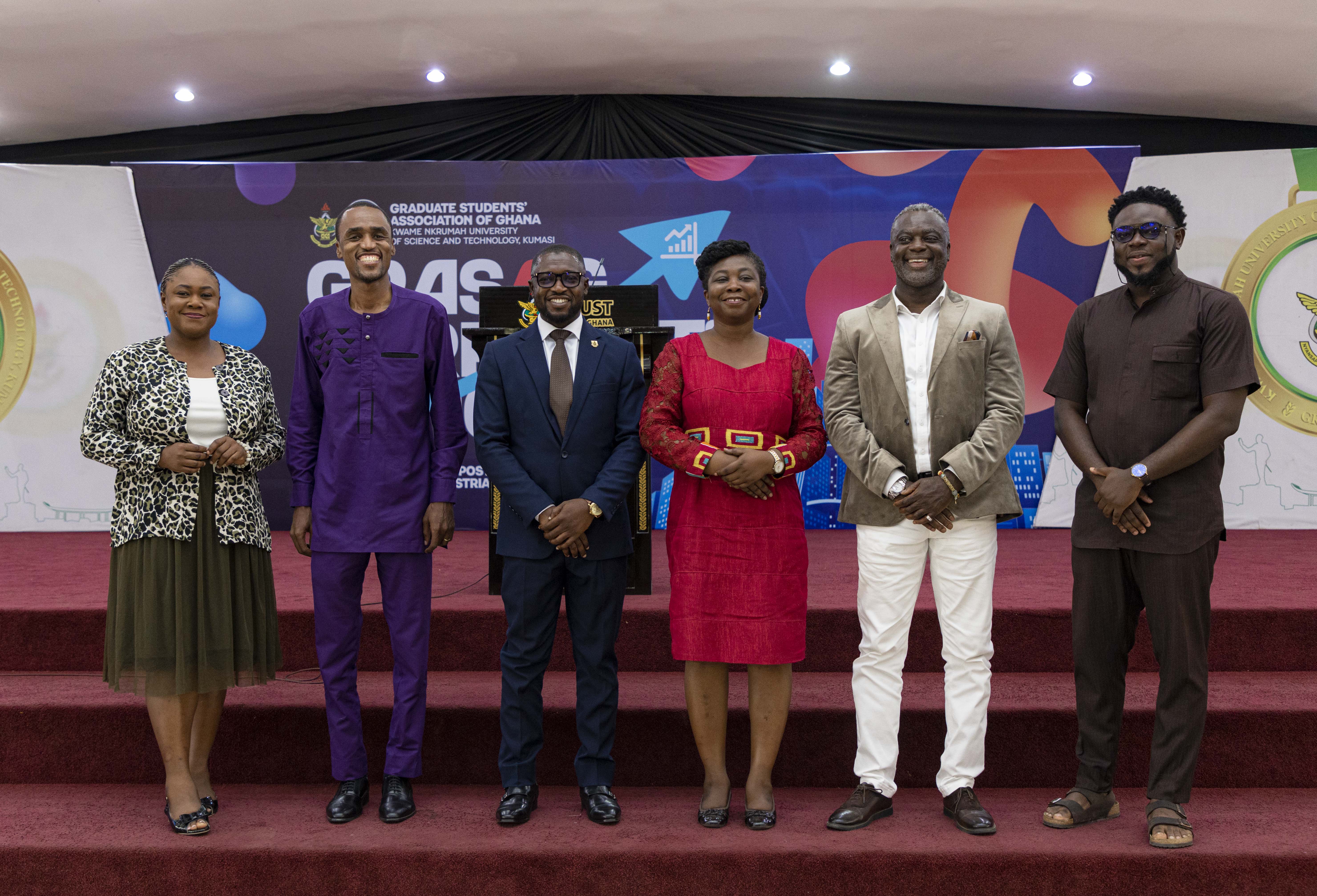
The Graduate Students Association of Ghana at the Kwame Nkrumah University of Science and Technology, Kumasi (KNUST) has held its 2026 Postgraduate Hangout under the theme “Bridging Postgraduate Research and Industrial Innovation,” bringing together academics, industry professionals and students to promote research translation, entrepreneurship and global collaboration.
GRASAG-KNUST President, Mr. Yussif Suleman, described the Corporate Hangout as a high-impact networking platform designed to connect postgraduate students with entrepreneurs, corporate organisations and policymakers.
He explained that unlike traditional academic seminars, the Hangout was structured to provide a relaxed yet professional environment that fosters informal mentorship and strategic partnerships.
According to him, the key objectives of the programme include networking, skill transfer and the commercialisation of students’ business ideas through pitching.
“We hope to leave here not just with knowledge and experience, but with business and entrepreneurship opportunities,” Yussif added.
Highlighting the University’s commitment to innovation, he noted that the best innovative business idea from the pitch session would receive start-up capital and further development support.
“The best innovative entrepreneurship idea shall not just receive start-up capital but will be trained further by the KNUST Centre for Business Development under the KNUST Business Incubator Programme and also be supported to secure more funding,” he said.

Professor Marian Asantewah Nkansah, Director of Student Affairs, said postgraduate research must move beyond theory and contribute meaningfully to national and local development.
“As a research-focused university, we are laying the foundation to equip our postgraduate students with leadership skills and competencies to be competitive in a rapidly evolving world,” she said.
She encouraged students to take advantage of the networking opportunities available at the event, engage speakers actively and build long-term professional relationships.
Mr. Evans Amoah-Nyamekye, an international legal practitioner and industry leader based in the United Kingdom, delivered an address centred on the theme.
Recounting his personal journey, he narrated how he was once labelled an “underachiever” in school, a moment he described as a turning point in his life.
“No one has the right to determine your future. You define your destiny,” he said.
Drawing on his international career experiences, Amoah-Nyamekye urged participants to develop globally competitive skills, seek international exposure and position their research to solve industry problems.
“The world needs you. Your research must connect to industry. Your innovation must solve problems,” he said.
He stressed the importance of collaboration, describing it as the pathway to elevation. “Build networks that extend beyond your fields,” he noted.
He further encouraged students to identify their unique skill sets, develop short-term goals and pursue innovation that creates measurable impact.
Ms. Sylvia Fafali Orou, Chemist and Lead Formulator at Falvich Enterprise, spoke on “Building a Brand in Ghana’s Competitive Market as a Young Entrepreneur.”
Encouraging participants, she said: “As young entrepreneurs, you are not just building businesses; you are shaping Ghana’s future. Remember, your brand is your promise, your identity and your gateway to partnerships, customers and global opportunities.”
She introduced the Business Model Canvas as a practical tool for aspiring entrepreneurs and highlighted the importance of compliance with regulatory frameworks and intellectual property protection.
Mr. Kojo Sam-Woode, Co-founder of Adroit Bureau Ltd and Chief Executive Officer of Sam-Woode Ltd, structured his address around three key principles for young entrepreneurs: discipline, resilience and innovation.
On discipline, he challenged students to evaluate their commitment to their goals. “How many hours do you work in a day?” he asked.
Speaking on resilience, he cautioned against unrealistic portrayals of entrepreneurship on social media. “There’s a wrong entrepreneurial narrative that is prevalent on social media,” he said.
He reminded participants that building a sustainable business requires patience. “Every business has a gestation period; find out the gestation period of the kind of business you want to start.”
On innovation, he urged students to leverage their individual strengths. “Find out what your unique resource is.”
Emphasising the advantage of postgraduate education, he added: “You are not starting with nothing. You are starting with knowledge.”
Sharing insights on developing professional networks among young entrepreneurs in Ghana, Mr. Samuel Chapirah Dery, Founder of Java Café, charged participants to strategically position themselves in ways that enable people to know, like and trust them.
By: Abigail Ofori


